
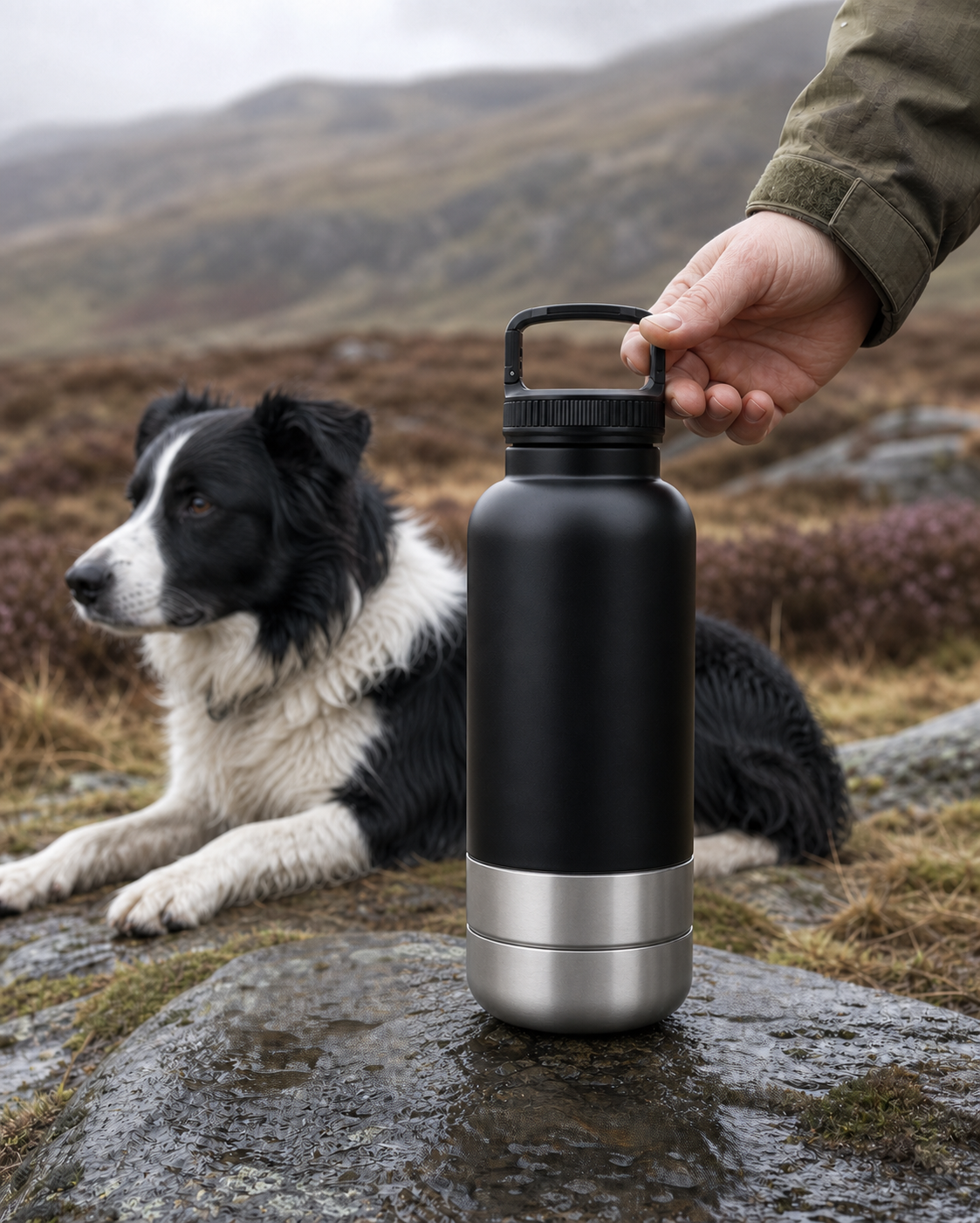
Choose a dog water bottle by checking how much usable drinking water it holds, how your dog will drink from it, how it fits your carrying setup, and whether every wetted part can be cleaned properly. Capacity alone does not tell you whether a bottle will work well on your normal walks.
A bottle that is easy to carry but awkward to offer may stay unused. A larger bottle can be useful on a longer outing but cumbersome on a short local loop. The aim is a dependable routine: bring appropriate water, make it accessible, offer it in a way your dog accepts, and clean the equipment afterwards. This guide helps you compare designs without assuming one capacity or material suits every dog.
Begin with the outing, not the product photo
Describe the walks for which you are buying. A short trip close to home, a journey by car and a longer countryside route create different carrying and refill requirements. Note whether you will have a bag, whether you can return easily, and whether there is a known safe place to refill. Do not treat a stream, roadside puddle or unverified public tap as a guaranteed drinking-water supply.
Think about who is carrying the water as well as who is drinking it. If you walk two dogs, carry water for yourself, or regularly hand the bag to another family member, the complete arrangement matters. A product photograph rarely shows the total load once leads, waste bags, phone, clothing and other essentials are included.
Conditions can change your plan. Route length, access, weather and your dog's individual needs should be considered together. This article is a buying and equipment guide, not a fluid-intake prescription. Ask your vet for individual advice if you are unsure about your dog's drinking needs or have a health-related concern. Buying a bigger bottle is not a substitute for changing an unsuitable outing.
Understand what the capacity actually describes

Look for a clear water-volume measurement rather than relying on a size label. Some products combine water and food compartments; a headline capacity may need clarification about which compartment it refers to. Ask whether the stated figure describes the water reservoir, the whole assembly or a bowl. The answer changes how you compare apparently similar bottles.
Ounce markings can also be ambiguous if the listing does not identify the unit system. For precise comparisons, request the usable water capacity in millilitres. Do not silently convert a product title into an exact volume when the supplier has not explained its measurement. A practical fill check after purchase can confirm how much water your own bottle holds.
Moorland currently lists a 32oz Stainless Steel Pet Water Bottle. “32oz” is the listing's stated capacity description, not a measurement carried out for this guide. The description also mentions food storage and a detachable design. Confirm the water-compartment volume and the exact components if those details determine whether it suits your route.
Consider the weight when filled
Compare a bottle as you will actually carry it, not only when it is empty. Water adds weight, and additional food, bowls or accessories add more. If you already own a suitable container, fill it with the amount you normally take and try the intended carrying position at home. This gives you a better sense of the load than looking at an isolated product image.
Check whether the bottle fits inside your bag securely and whether you can reach it without unloading everything. A side pocket may be convenient, but its depth and opening need to suit the bottle's shape. A shallow pocket that looks right while standing still may not hold the item securely when you bend to pick up waste or adjust your shoes.
Do not assume a carrying loop or clip is rated for every attachment method. Follow the product's instructions and inspect the connection before use. Keep bottles and accessories separate from restraint equipment unless a manufacturer specifically intends otherwise. A convenience clip is not a lead attachment, and a storage bag is not a substitute for suitable dog-handling equipment.
Check how the dog will drink
Common arrangements include a separate bowl, a detachable cup or a built-in drinking section. The useful question is whether your dog can comfortably reach and use that shape. Consider the opening, depth and stability, not merely whether the package includes something called a bowl. Your dog may already have a preferred familiar container that works better than an unfamiliar integrated design.
Try a new drinking arrangement at home before depending on it away from home. Set it up on a stable surface and give your dog time to investigate without pressure. Watch how easy it is to offer water and whether the container tips or slides. A supervised familiarisation check is more helpful than discovering an awkward fit halfway through a planned walk.
Keep the process simple enough to manage while holding a lead appropriately. Can you open the bottle without putting small parts on the ground? Can the bowl stand while you secure the lid? If the design needs two hands, plan a calm stop rather than trying to operate it while moving. Equipment should support a sensible pause, not create another task during a difficult moment.
Separate useful features from unsupported promises
A material name does not establish all of a bottle's performance. A stainless steel reservoir can still have seals, plastic components and joints with their own care requirements. Do not infer that an item is dishwasher-safe, insulated, leakproof or suitable for hot liquids because another stainless steel bottle has those features. Ask about the exact product and each relevant part.
The current Moorland listing describes stainless steel construction and sections that separate for cleaning. This guide has not independently tested corrosion resistance, odour retention, insulation or sealing performance. If leak resistance is essential because the bottle will share a bag with electronics, request the supplier's instructions and assess the item before placing it beside anything vulnerable.
Be equally careful with photographs. A bottle shown lying on its side is not a leak test. A cold-looking drink is not evidence of insulation. A dog pictured beside a bottle is not proof of capacity suitability for that dog. Use images to understand shape and colour, then use instructions, measurements and an appropriate practical check to assess function.
Inspect the lid and seals
Look for clear opening and closing instructions. Does the lid screw on, latch, or use a push mechanism? Are there removable seals, and can they be replaced or reinstalled correctly? If the listing does not show those details, ask. A bottle is an assembly, and a small damaged or misplaced component can affect how the whole item works.
After purchase, inspect for visible damage, loose components and obvious mismatches with the listing. Follow the supplied preparation instructions before use. If a seal is missing or a lid does not close normally, stop and contact the retailer rather than improvising a repair that might affect suitability. Keep any small detached components away from your dog.
Where the instructions permit, check the closed bottle over a sink or another suitable place before carrying it in a bag. Record what you actually observe; a brief home check is not a lifetime leak guarantee. Recheck after cleaning and periodically during use, especially if a seal has been removed or the bottle has been dropped.
Make cleaning part of the buying decision
Every surface that contacts drinking water needs an appropriate cleaning method. Think about the reservoir, threads, spout, bowl and any narrow channel. Can you see and reach those areas? Does the product separate without tools, and do the instructions explain reassembly? A detachable design is only convenient if you can clean and put it back together correctly.
Read the care instructions before selecting detergent, water temperature or cleaning equipment. Do not put a bottle or its parts in a dishwasher unless that use is specifically allowed. Similarly, do not assume sterilising, boiling or soaking is suitable for every seal or component. Material compatibility depends on the whole product, not just the most prominent material in its title.
After cleaning, follow the drying and storage instructions and avoid trapping residual water in inaccessible parts. If a component develops damage, a persistent problem or an unexplained smell despite appropriate care, stop using it while you seek advice from the retailer. The aim is an inspectable, maintainable routine, not a claim that one material can never retain odours.
Food storage is a separate requirement
A combined food-and-water product may reduce the number of containers you carry, but check the compartments individually. How much food space is available? Is it suitable for the type of food you intend to take? Can the sections stay separate during normal use? Do not assume a dry-treat compartment is suitable for wet food or extended storage without relevant instructions.
Think about whether you actually need food storage on the outings you have described. For some routines, a separate familiar treat pouch may be easier to access. For others, a combined design may be useful at a planned stop. Neither arrangement is automatically better; choose the simplest setup that covers your actual needs without creating difficult cleaning or carrying tasks.
The Moorland bottle description mentions keeping water, food and a feeding solution together. That establishes how it is presented in the listing, not the capacity or suitability of every compartment for every food. Verify any unresolved detail before relying on the bottle as your only feeding or drinking arrangement for a trip.
Plan refills and a sensible backup
Identify refill opportunities before leaving and distinguish a confirmed drinking-water source from an assumption. Opening hours, access and seasonal availability can change. If your plan depends on a café or visitor centre, check it for that outing. A route with no reliable refill needs a different carrying plan from a short walk with an easy return home.
For car journeys, keep water accessible for planned stops rather than buried beneath luggage. Do not use a boot liner, loose mat or other comfort accessory as a restraint system. Water provision and travel safety are separate decisions. Review applicable official travel guidance for your location and use suitable, correctly fitted travel equipment.
If the bottle is new, a familiar spare bowl or container can make the first outings less dependent on one unfamiliar component. The right backup depends on your trip; it need not mean buying several products. A shorter first route can also help you assess the carrying setup before using it on a longer outing.
Compare two options with the same checklist
Write one row for each candidate rather than comparing a feature-rich advertisement with a brief product description. Record usable water volume, empty and filled carrying weight where known, drinking arrangement, bag fit, opening method, cleaning instructions, spare-part information and the remaining questions. Mark missing information as unknown instead of rewarding the more confident wording.
Imagine Option A is easier to carry but has an unspecified water compartment, while Option B has clear capacity information but a bowl your dog has never used. The next steps differ: ask a capacity question for A and assess bowl suitability for B. Neither uncertainty is solved by choosing the highest review count or the largest headline number.
Reviews can suggest useful questions, such as whether lids are fiddly or a bowl is small. They do not establish your dog's acceptance or replace instructions. Also distinguish product reviews from experience with the retailer's delivery and support. Imported marketplace reviews may describe a different seller or variant, so check their source and exact-product relevance.
Your pre-order and first-use checklist
- Describe the route and the people and dogs sharing the carrying setup.
- Confirm usable water volume and separate compartment capacities.
- Check the drinking opening or bowl against your dog's normal use.
- Assess the filled load and how securely it fits your bag.
- Read lid, seal, cleaning and drying instructions.
- Identify reliable refills and a practical backup.
- After arrival, inspect and familiarise at home before a longer outing.
A good bottle makes water provision straightforward; it does not remove the need to plan. Compare the current Moorland water-bottle details with your checklist and ask about any missing capacity or care information. For the broader carrying routine, read what to pack for a longer dog walk. Choose around your real outing, not a universal daily-volume rule or a product photograph.

Leave a comment
This site is protected by hCaptcha and the hCaptcha Privacy Policy and Terms of Service apply.