
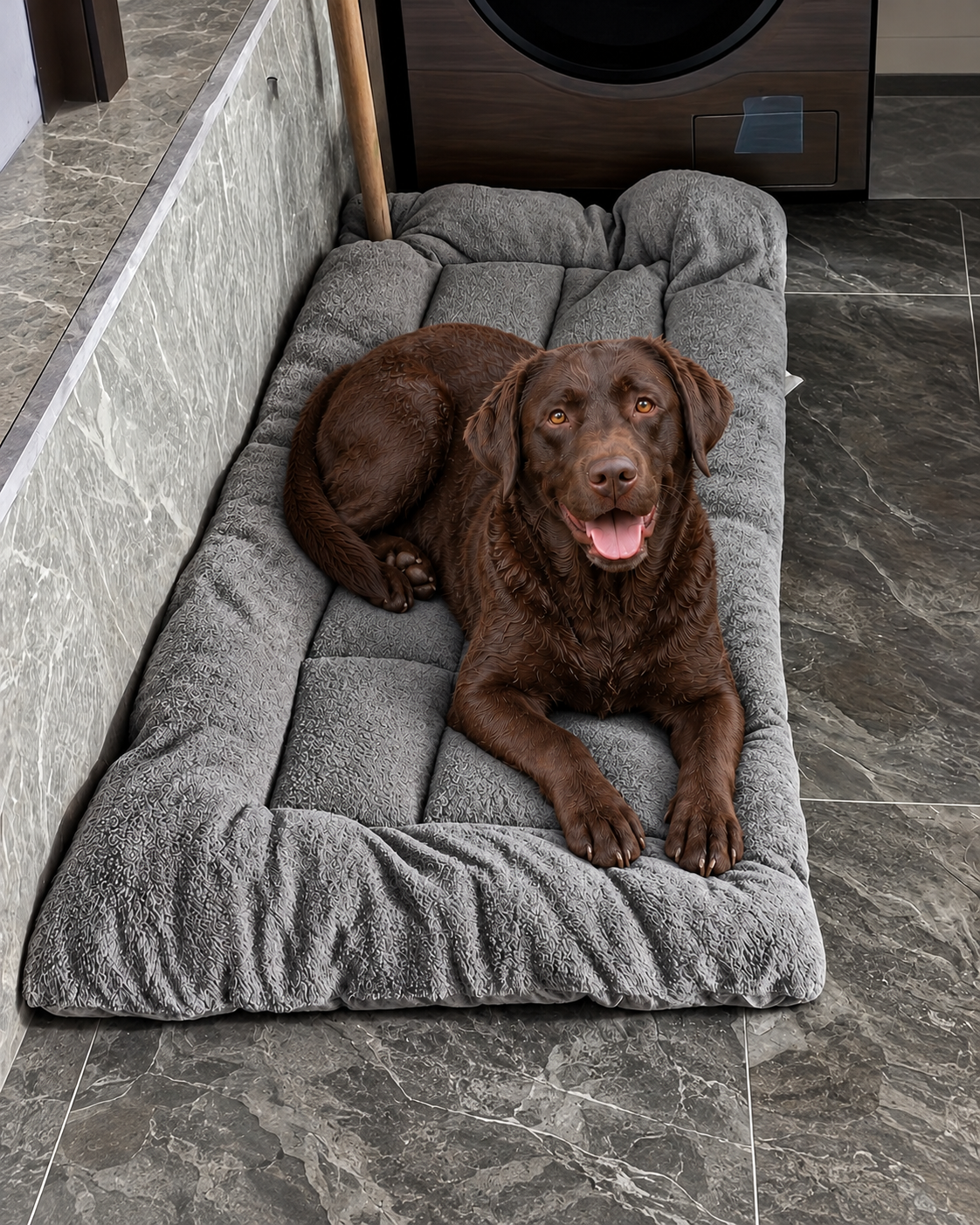
To choose a dog mat that fits, measure your dog in their usual sleeping positions, measure the available floor or crate space, and compare both with the product's usable resting area—not just its overall dimensions. A breed label, photograph or the word “large” cannot do those checks for you.
A mat can look generous in a product photo yet be too narrow for a dog that sleeps on their side. A larger mat can also bunch against furniture or prevent a crate door from moving freely. The useful question is not “Is this a big bed?” but “Does this particular shape fit my dog and the place where they rest?” This guide gives you a repeatable way to answer that before ordering.
Start with how your dog actually rests
Watch a few ordinary rest periods before reaching for the tape measure. Does your dog curl into a compact circle, stretch out with their legs forward, or change between both positions? Do they lean their head on an edge, rest flat, or move away from padded sides? A single curled-up snapshot can underestimate the space they use over an afternoon.
Make a short note of the positions you see, without trying to train your dog into the pose that suits a particular product. If they use several beds or floor spaces, notice which they choose and when. The location, temperature, household activity and surface may all influence that choice. Treat these observations as information about your own dog, not a universal rule for their breed.
Do not disturb a sleeping dog to take measurements. You can wait until they get up and measure the area they occupied, or photograph the position with a familiar object nearby for reference. The photograph helps you remember the shape; it is not an accurate substitute for a tape measure. If your dog dislikes being approached while resting, keep the process entirely hands-off.
Measure the sleeping footprint, not only body length
Body length and the space needed to rest are different things. A dog lying on their side may have paws extending beyond their chest and a tail outside the line of their back. Measure the longest and widest dimensions of the footprint they normally occupy. Repeat for another common position so that you are not choosing around the smallest possible outline.
Write down the units with every measurement. A note saying “90 by 50” is less useful a week later if you cannot remember whether it refers to the dog, the room or the product. Use three labelled entries: dog's resting footprint, available space, and proposed mat dimensions. Keep the measuring direction consistent, especially when a room only allows the mat to lie one way.
Allow sensible room for your dog to reposition, but do not adopt a fixed extra-centimetre rule as a guarantee. Different shapes, edge heights and sleeping habits change what feels usable. If your dog already has a well-fitting mat, measure its resting surface and compare the new option with that reference. This is often more informative than guessing from weight alone.
Separate overall dimensions from usable space

Overall dimensions describe the outside of a product. Raised edges, bolsters, seams and curved corners can reduce the area available for lying flat. A rectangular mat with cushioned edges should therefore not automatically be treated as a completely flat rectangle of the stated size. Ask whether a measurement refers to the outside, the centre, or a removable insert.
If the listing gives only overall measurements, look for a top-down image and request clarification rather than calculating an exact centre size from perspective. A dog's body can obscure the edges in a lifestyle photograph. Photography is useful for understanding appearance and construction, but it does not establish the sleeping area, thickness under load or suitability for your dog.
For Moorland's Trail-Rest Plush Dog Mat, the current listing gives a supplier-listed approximate size of 120 × 60 cm and a stated measuring tolerance of 1–3 cm. Those are supplier dimensions, not an independently measured sample result. The listing describes a quilted centre and cushioned raised edges; it does not provide a separately measured usable centre area.
Make a floor template before buying
A simple outline makes a measurement feel real. Mark the proposed outside dimensions on the floor using removable tape suitable for that surface, or lay out paper in the same rectangle. Keep loose materials away from dogs that might chew or swallow them. The outline is a planning tool, not something to leave unattended as part of their resting area.
Look at the space from the doorway and from the places people usually walk. Can someone pass comfortably? Does a cupboard, radiator valve or chair leg intrude? Will the mat end up folded because the only convenient location is narrower than the product? Check doors through their full movement, not simply in the position they happened to be in while you measured.
Now compare the outline with your dog's recorded footprint. Imagine the raised edges occupying part of that rectangle. If the fit is already marginal before accounting for the edges or size tolerance, ask for more information or consider another shape. A mat that technically fits a gap is not necessarily a good resting place once the dog and everyday household movement are included.
Crate fit needs its own check
Measure the inside floor of the specific crate, including any tray lip, rounded corner or obstruction. External crate dimensions can include the frame and are not the same as usable floor space. Check the opening and door movement too. A thick or oversized mat should not stop a door closing normally or interfere with the crate's intended operation.
Compare the mat's dimensions and tolerance with that internal space. Do not assume a soft item can simply be squeezed into a smaller crate. Bunching changes the resting surface and may expose edges to chewing. If the supplier has not confirmed compatibility, treat “crate mat” as a suggested category of use rather than proof that it fits every crate of a familiar size.
The Trail-Rest listing suggests checking measurements against a crate floor; it does not certify universal crate compatibility. Your own measurements remain necessary. For a dog that chews bedding, or one with particular comfort or mobility needs, ask an appropriate professional about suitable bedding rather than expecting a plush mat to solve the issue. No fabric surface should be assumed chew-proof.
Choose the location before choosing the colour
A quiet corner that your dog already likes is a more useful starting point than the room's most photogenic spot. Think about drafts, direct heat, doorways and the normal movement of children, visitors and other pets. Give your dog space to leave the resting area rather than placing it where they can be surrounded or repeatedly stepped over.
Check the floor beneath the proposed mat. Do not assume the backing prevents movement on every tile, laminate or wooden floor unless the product evidence specifically supports that claim. Watch what happens when your dog steps on and off a new item during a supervised introduction. If it moves unexpectedly, stop and reassess the setup instead of relying on the product name.
Grey can be visually easy to place, but appearance is secondary to fit, care and practical use. Also consider whether you can reach all sides for cleaning and lift the mat without dragging it through narrow furniture. A resting place that is easy to maintain is more likely to stay part of a comfortable everyday routine.
A mat and a deep-sided bed are not interchangeable
A lower-profile mat and a bed with more substantial sides offer different layouts. Some dogs like an open surface; others often choose somewhere to lean. Neither preference proves a medical need, and neither design is automatically best. Compare the actual product shape, entry height, resting area and care instructions rather than assuming that more padding always means more suitable support.
Moorland also lists the After-Walk Comfort Dog Bed. Use the individual listings to compare shape and available options, then measure the exact size you are considering. Do not transfer measurements, filling details or washing instructions from one product to another because they look similar or belong to the same range.
If your dog has pain, struggles to get comfortable or has difficulty getting up, product shopping is not a substitute for veterinary advice. The Trail-Rest product information used for this guide does not establish orthopaedic performance, pressure relief or treatment benefits. Choose bedding around the dog's needs with professional input where required, not around an unsupported therapeutic label.
Check the cleaning routine you can sustain
Before ordering, find out how the complete item should be cleaned. “Soft” and “plush” do not tell you whether a cover is removable, whether the filling can be washed, or how long drying might take in your home. Ask separately about the cover and inner parts where relevant. Avoid assuming that similar-looking products share the same care instructions.
The current Trail-Rest listing specifies hand washing, based on supplier instructions. It does not establish machine-wash or tumble-dry suitability. If hand washing a large mat would be impractical for you, that matters as much as the colour. Think about your washing space and where the item can dry fully without blocking a busy household area.
For muddy days, a separate clean-up routine can reduce how much dirt reaches a resting place. Keep the routine gentle and appropriate for your dog, and follow product-specific care information. A plush surface is not a promise of waterproof protection. Avoid placing the mat where water, accidents or cleaning products could damage the floor beneath it without a suitable, independently chosen arrangement.
Introduce the new resting place without forcing it
When the mat arrives, compare it with the listing and your measurements before making it the only resting option. Check the seams, surface and any loose components. Follow the supplied care or preparation instructions. Photograph any discrepancy while the item and packaging are still available, and use the store's current contact and returns information if clarification is needed.
Place it in the chosen location and let your dog investigate at their own pace. Keep the first use supervised, particularly if they are likely to chew unfamiliar items. Watch whether they can turn, stretch and step off easily. A dog standing on a mat once does not demonstrate that it suits their normal sleeping position.
Keep a familiar alternative available while you assess the new arrangement. If your dog consistently rests half on and half off the mat, note whether that appears to be a preference or a lack of space. You are looking for a practical fit in normal use, not a staged photograph that proves the purchase was right.
A worked measuring example
Imagine a dog whose relaxed side-lying footprint is 95 × 55 cm. The proposed room space is 130 × 80 cm, and a candidate mat is listed as approximately 120 × 60 cm overall. These are invented example measurements, not a recommendation for a particular breed or a test result for a Moorland product.
The mat may fit the room, but the width deserves another check: the dog's 55 cm footprint is close to the 60 cm overall width before accounting for raised edges, normal repositioning or manufacturing tolerance. The correct next step is to confirm the usable area and consider alternatives—not to conclude that the larger overall length guarantees a fit.
Changing the room dimensions would answer a different question. More floor space does not make the mat's sleeping area wider. Keeping the dog, room and product measurements separate prevents this common mistake and makes a useful question easy to send to the retailer: “What is the flat resting area inside the edges of this exact option?”
Questions to answer before ordering
- What footprint does my dog use when stretched out and curled up?
- Are the stated product dimensions overall or usable measurements?
- What tolerance applies, and is my proposed fit too tight?
- Does the location allow easy access, movement and cleaning?
- If using a crate, have I measured its internal floor and checked the door?
- Can I follow the actual care instructions?
- Am I expecting any benefit the listing does not substantiate?
The best next step is a measurement, not a guess. Review the Trail-Rest Plush Dog Mat's current size and care information, compare it with your notes, and ask about any missing usable-area detail before ordering. Product photos help you choose a look; your dog's real resting footprint helps you choose a fit.

Leave a comment
This site is protected by hCaptcha and the hCaptcha Privacy Policy and Terms of Service apply.