
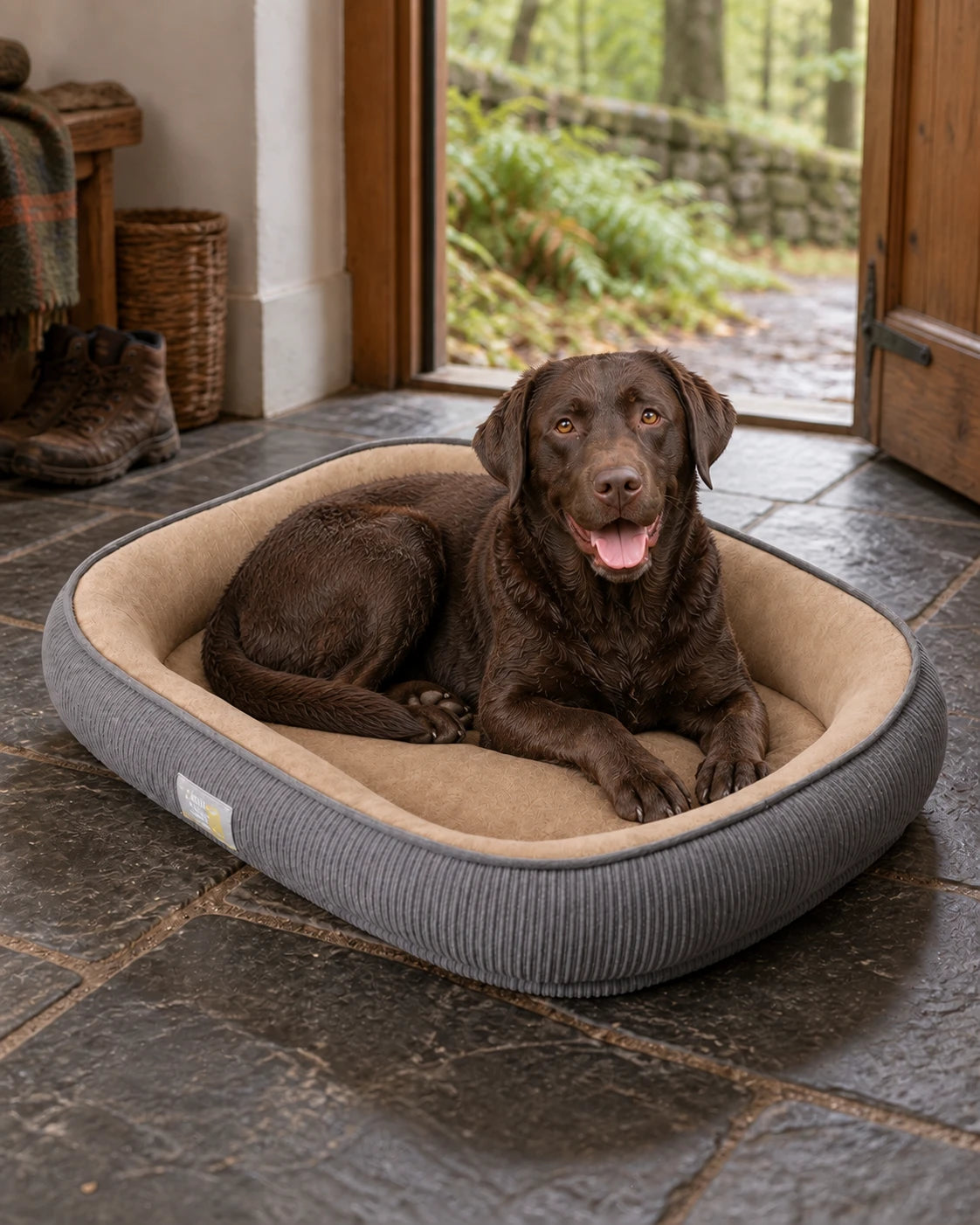
A useful resting corner gives your dog an appropriate place to settle without being repeatedly stepped over, approached or moved. Start with the household's movement and the places your dog already chooses. Then assess space, access, comfort and care before deciding whether a new bed or mat is needed.
In a busy home, the most photogenic corner is not always the most practical one. A spot beside the sofa may be a main route to the kitchen; a quiet-looking hallway may fill with coats and visitors. The aim is not to hide the dog away. It is to make rest possible within the home you actually share.
Begin with the resting place, not the product
The RSPCA's home-environment guidance includes a comfortable, clean, dry, quiet and draught-free place where a dog can rest without disturbance. It also recognises the need for access to a safe retreat. Those needs are broader than the appearance or price of a bed.
Look at the room before browsing. Which routes do people use most often? Where do doors open? Where do children play or visitors gather? Mark the places that would require everyone to step around the dog each time they cross the room.
Then identify a possible alternative. It may be close to the household without being in the main passage. You do not need a separate room to begin the assessment, but you do need to consider whether the chosen location allows the dog to rest and leave comfortably.
Notice the choices your dog already makes
Observe ordinary resting behaviour without staging it. Where does the dog choose to lie when the house is quiet? Does that change when visitors arrive or another activity begins? These observations can inform the layout, although they do not diagnose a health or behaviour problem.
Keep familiar options available while considering a change. Do not remove the only established resting place simply because a new arrangement looks better. A dog standing on a new mat once does not demonstrate that it suits their normal rest.
If your dog has difficulty getting comfortable, changes their usual behaviour or seems in pain, seek veterinary advice. A room-layout exercise and a new product cannot answer that question. Keep the concern separate from the styling decision.
Map the room at its busiest time
A corner can work in the morning and become inconvenient during dinner preparation or school pickup. Look at the room during the activity that creates the most movement. You are not looking for permanent silence; you are looking for repeated interruptions that can be reduced.
Think about doors, cupboards and furniture used frequently. A mat in front of a cupboard may be moved several times a day. A resting place under a chair that is regularly pulled out may create another conflict. The furniture's normal use matters as much as its shape.
Choose a location with a defined job. If the space is also a bag drop, laundry pile or children's play corner, agree what changes when the dog is resting there. A resting area cannot stay useful if every other household item gradually claims it.
Keep access and exit clear
Check the dog's route into and out of the area. Avoid a setup that corners them between people and furniture or requires someone to move the bed whenever a door opens. The location should remain usable beyond the first tidy arrangement.
Also consider the people who need to move through the room. Do not block a doorway, essential route or access feature. A larger bed is not an improvement if it makes ordinary movement awkward for the household.
If mobility or specialist access needs affect the dog or a person, follow the relevant individual advice. Do not copy a layout from a photograph and assume it works in another room. Your plan should fit the actual dimensions and users.
Measure the place and the usable resting area
Measure the floor space available, then compare the exact product's dimensions and shape. Overall dimensions and the area available inside raised edges can be different. Do not treat a product label such as large as a substitute for that comparison.
Our dog-mat sizing guide explains how to separate the dog's resting footprint, the room space and the candidate item's usable area. Use it for the detailed measurement task rather than guessing from a dog posed in a product photograph.
Moorland's Trail-Rest Plush Dog Mat is one option to compare. Its current listing gives supplier dimensions and care information; this article does not independently verify its fit, support or suitability for every dog.
Choose the surface for the actual floor
Consider what sits beneath the bed or mat and how the arrangement behaves in normal use. Do not assume a backing prevents movement on every type of flooring unless the exact product evidence supports that claim. Observe the first use appropriately and stop if something is unsuitable.
Keep the area separate from wet equipment or cleaning products. A plush appearance does not establish waterproof protection, and a product photo cannot tell you what will happen to the floor beneath it. Choose any additional protection through its own suitable evidence and instructions.
Check that you can reach the area for normal care without dragging a large item through furniture. The most practical corner is one the household can maintain, not one that becomes inaccessible after the bed is placed.
Agree what undisturbed means
Tell household members that the resting area is not the place to call the dog over repeatedly, climb across them or move their bedding casually. Keep the expectation clear and appropriate to the people involved. Adults remain responsible for supervising children around dogs.
If someone wants to interact, they can choose an appropriate moment rather than treating a resting dog as always available. A shared rule is more useful than one person repeatedly correcting others after the space has already been disturbed.
For concerns about interactions, guarding or behaviour, seek qualified help rather than improvising a treatment through furniture placement. This article describes a practical household boundary; it is not a behaviour-modification programme.
Keep visitors informed without a long explanation
A visitor may not recognise that a familiar-looking corner has a particular purpose. A brief explanation can help: the dog is resting there, the route past the area stays clear and interaction is not required. Do not assume everyone knows the household's arrangement.
Consider where bags, coats and children's belongings will go before visitors arrive. If they normally land in the resting area, choose another suitable location. The rule is easier to follow when the alternative is obvious.
Do not force visitors and the dog into a close interaction to demonstrate that the setup works. The household can be welcoming while preserving appropriate space. A resting corner should not become a stage for introductions or photographs.
Care requirements are part of the location
Read the exact bed or mat instructions before choosing how it will be cleaned and dried. A cover, filling and complete item may have different arrangements. Do not infer machine-wash suitability from softness or from another product in the same shop.
Think about where the item goes during care. Is there an appropriate alternative resting place while it is unavailable? Can the household complete the required process without blocking another essential area? These are practical questions to answer before purchasing.
Keep care information accessible to anyone responsible for the dog. The resting area should not depend on one person remembering an instruction that was discarded with the packaging.
A busy-living-room example
Imagine a fictional home where the dog usually rests beside a sofa, directly in the route between kitchen and door. People repeatedly step around the bed and move it when carrying shopping. The household initially thinks a smaller, more attractive mat will solve the problem.
After looking at movement, they choose another suitable position within the room and keep the main route clear. They compare the available space with the dog's normal resting footprint and retain a familiar option during the change.
The useful improvement is the location and shared expectation, not a promised effect from a new fabric. The household has solved a repeated interruption without claiming that the dog has received a medical or anxiety treatment.
An open-plan example
Now imagine a room used for cooking, work and evening television. There is no single quiet time that lasts all day. The household considers whether different appropriate resting options are needed as activities change, rather than forcing one corner to serve every situation.
They choose locations that preserve access and allow the dog suitable choice, following relevant professional advice if needed. They do not close off the dog in an unsuitable space simply to make the main room tidier.
The example is not a universal layout. It shows why observing the whole day can be more useful than choosing the quietest corner during one calm afternoon. A home is a changing environment, not a still photograph.
Introduce the arrangement without a performance test
If more than one dog shares the home
Do not assume one large bed replaces appropriate resting resources for every dog. The RSPCA's environment guidance also advises providing sufficient separate resources in a multi-dog household. Consider the actual dogs, their established arrangements and any professional advice rather than dividing the room by a photograph of animals resting together.
Record which resting areas are normally available and whether a household activity removes one. For example, moving a bed out of a guest's way may leave fewer suitable options than you intended. Keep those changes visible to the people responsible for the dogs. A resource is only useful if it remains available in the circumstances for which it was chosen.
If there is tension around resting places, do not try to solve it by forcing the dogs to share or by buying a supposedly calming product. Seek qualified advice and manage the situation appropriately. The room plan can help describe the practical arrangement to a professional, but it cannot diagnose the cause or supply a treatment. A clear account of locations, access and recent changes is more useful than a claim that a larger bed should have fixed everything.
Place an appropriate item in the chosen location and allow the dog to investigate without forcing them to stay. Keep the first use supervised where relevant, particularly around unfamiliar components or a dog likely to chew. No textile item should be assumed chew-proof.
Notice whether the area remains clear and whether the household follows the agreed boundary. Those are observations you can use to adjust the setup. You do not need to interpret every movement as a verdict on the purchase.
If the dog consistently chooses somewhere else, review the practical factors and seek advice where there is concern. Do not remove alternatives or repeatedly reposition them for a photograph intended to prove that the new corner is successful.
Review the corner as a shared space
After several ordinary days, ask which interruptions remain. Is a cupboard still blocked? Do bags accumulate there? Does a visitor route pass too close? Fix the specific issue rather than expanding the project into a complete room makeover.
Keep the arrangement flexible when furniture or routines change. A corner that worked before a desk was added may need another look. The purpose remains the same even if the position changes: an appropriate place for rest within a usable home.
A small note can preserve the useful decisions: location, exact product if any, care reference and the household boundary. Do not turn observation into a constant behaviour score. The aim is practical clarity, not monitoring every nap.
Your resting-corner checklist
- Start with the dog's existing choices and any individual professional advice.
- Map movement at the room's busiest times.
- Keep entrances, exits and essential household routes clear.
- Compare room space with exact product and usable-area measurements.
- Agree an undisturbed boundary and visitor arrangement.
- Plan item-specific care and a suitable alternative when needed.
Choose the place before the picture. A quieter resting corner is a practical household arrangement, not simply a new bed. Observe the room, preserve appropriate choice and make the shared boundary easy to understand.

Leave a comment
This site is protected by hCaptcha and the hCaptcha Privacy Policy and Terms of Service apply.